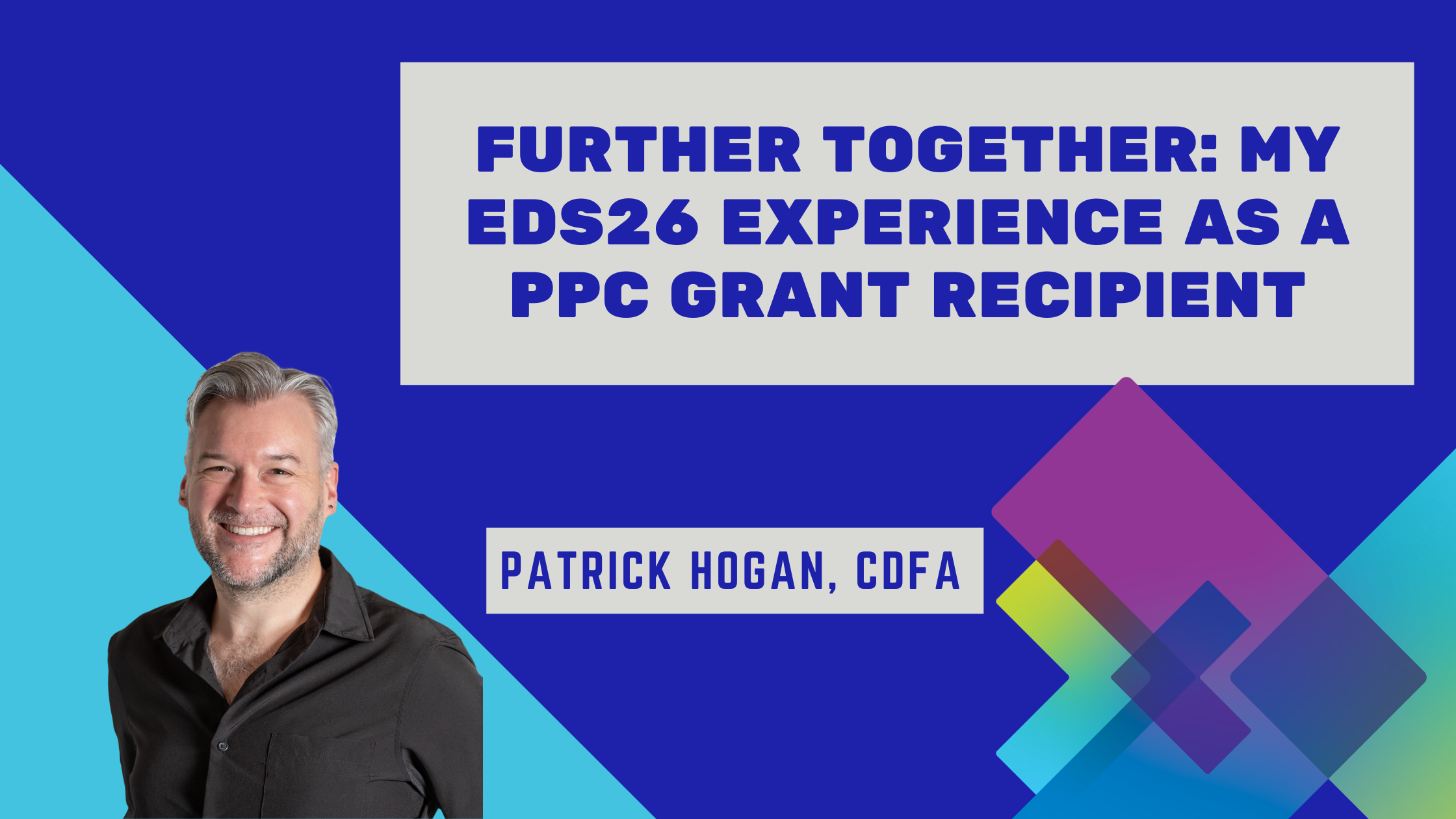
When I learned I had been awarded the PPC Foundation Grant to attend EDSymposium26 in Atlanta, I was genuinely moved. It's one thing to want to invest in your professional growth; it's another to have your community invest in you. That generosity set the tone for everything that followed.
Arriving Early: The Pre-Conference Workshop
I attended the pre-conference workshop, "Influence is Power: Building Credibility, Clarity, and Confidence," and it was one of the best professional decisions I've made. The full-day session was led by leadership consultant and communication strategist Skot Waldron, with a companion case study facilitated by Deborah Gill, FSDA, CPA and together, they delivered a workshop that was both intellectually practical and personally challenging in the best ways.
Skot opened with a framework of the 4 C's of Influence: Character, Chemistry, Competency, and Credibility. The premise was deceptively simple. Influence isn't something you demand or claim by title. It's something you build, deliberately and consistently, through how you show up every day. As a firm administrator, I sometimes wrestle with how to make my voice matter in an office where architects are the biggest voices in the room. Skot's model gave me language for something I had felt but couldn't articulate; that influence is earned through character, chemistry, competency, and credibility — and that each of those can be developed intentionally.
What made the workshop more than motivational was Skot's honest treatment of what gets in the way. As someone who tends toward high competence and low warmth in what Skot called the "brilliant jerk" zone; it was both humbling and clarifying to recognize that leaning into warmth isn't a soft skill. It's the thing that determines whether people actually want to follow you. He also walked us through self-preservation tendencies and the fear-driven behaviors that cause us to hide, prove, or protect ourselves rather than lead openly. Seeing those patterns named so clearly made it easier to understand how to move past them; both in myself and in the team dynamics I navigate every day.
The workbook exercises kept the content grounded. One that hit particularly hard: mapping out the things I can't control, the things I can control, and the things I can influence. In operations and administration, it's easy to get consumed by the I can't control part and paralyzed by it. Shifting focus to the third column — the space of influence — reframed my entire approach to navigating firm dynamics.
Deborah Gill's case study brought these leadership concepts into sharp relief within a real A|E firm context. Walking through how a financial leader transformed a struggling design firm, eliminating debt, growing staff, and tripling revenue, wasn't just inspiring, it was instructional. She connected the 4 C's directly to practical outcomes: that competency and credibility in financial management aren't just professional assets; they are the foundation of becoming a trusted advisor who shapes a firm's future. I came away with a much deeper appreciation for how the work I do as an administrator directly supports, or undermines, that kind of transformation.
Thursday: The Conference Begins
One of the things I love most about SDA conferences is that the community genuinely shows up for one another; reconnecting with familiar faces and meeting new colleagues from across the country who face the same challenges I do every day.
Simon Goodhead opened with a keynote titled "Strengthening the Business Behind the Design," and it was a strong anchor for the day ahead of us. His framework for the five transitions every firm must navigate, ownership, management, governance, client/sales, and leadership, made clear that leadership is the hardest of all, precisely because it depends on followship, not authority. Simon's point landed hard: "Leadership is a title; followship is the only evidence of leadership success."
He traced how two major disruptions, the 2008 recession and the 2020 COVID pivot, effectively hollowed out the leadership pipeline in A|E firms. The recession froze hiring and stalled careers for a generation of would-be mid-level leaders. Remote work then killed the "osmosis" of learning, the informal, observational development that happens when junior staff sit near senior leaders and absorb how decisions get made. And now, AI is potentially outsourcing the kind of productive struggle that develops real leadership instincts. As Simon put it, if we outsource the hard thinking to AI, we never develop the authentic gut required to lead in a crisis.
His prescription was: trust people first, allow them to make mistakes, expose rising leaders to partner-level conversations, and understand that the velocity of learning accelerates dramatically when people are immersed in real experience rather than passive instruction.
As a firm administrator, I don't always see myself as part of the leadership pipeline conversation, but Simon's session reframed that for me. The work we do creating structure, supporting communication, and holding the operational fabric of a firm together is not just administrative background noise. It is the infrastructure on which followship is either built or broken.
Eric Keens and Amita Singh followed with a session on brand messaging: "Speak Your Brand: Messaging That Moves & Motivates." Their three-part framework (who we are, what we promise, how we show up) gave us a concrete way to audit whether our firm's communications reflect our identity. The "win theme recipe" they introduced; connecting a client's challenge to a specific firm benefit, feature, and proof point, is something I immediately want to bring back to our proposal and marketing conversations.
Kevin Hebblethwaite's session, "Leadership Development: Climbing With or Without a Ladder," spoke directly to something many of us in the room felt but hadn't fully named: in today's flatter firm structures, leadership growth rarely follows a clear or traditional path. Kevin reframed that not as a problem to solve, but as an opportunity for individuals to build influence, credibility, and visibility at any career stage, and for firms to be more intentional about growing and retaining talent without relying solely on formal hierarchies. For business operations professionals especially, that message hits close to home. We often develop real leadership capacity without the title to show for it, and this session made the case that the path forward is worth building deliberately, even when the ladder isn't there.
The afternoon closed with a panel: "Innovation at Risk: Intellectual Property, Insurance, and R&D Tax Credits in Today's A|E Firms" featuring Kristen Walker, Lisa Thompson, Meredith Kowal, and Suzannah Gill. The afternoon panel on intellectual property, insurance, and R&D tax credits was a reminder that some of the most valuable learning happens in the sessions you didn't know you needed. Lisa Thompson's breakdown of copyrights, trademarks, and patents in the A|E context gave me a much clearer picture of what our firm actually owns and how long those protections last. Meredith Kowal's overview of R&D tax credits opened my eyes to the value we may be leaving on the table. And Kristen Walker's breakdown of IP insurance: defense coverage, pursuit coverage, and business interruption sent me home with a list of questions for our principals and our broker.
The Bigger Picture
What I keep returning to, now that I'm back at my desk, is how much the conference's theme Further Together was lived out rather than just stated. From Skot Waldron's pre-conference challenge to lead through influence rather than authority, to Simon Goodhead's call to rebuild the leadership pipeline deliberately, to the practical tools every session sent me home with, EDS26 reminded me that none of us are doing this work alone, and that we don't have to.
As an office administrator, it can be easy to feel like a supporting role in someone else's story. This conference helped me see that differently. Influence doesn't require a different job title. Credibility isn't assigned; it's built. And the work we do in operations, administration, and firm management is directly connected to whether the people around us can follow, grow, and lead.
I am deeply grateful to the PPC Foundation and the Grant Committee for making this experience possible. To anyone considering applying for next year: do it. Arrive a day early. Stay for all of it. The investment will come back to your firm many times over, and to you in ways you won't fully see until you're back home, putting it all into practice.
Patrick Hogan is the Office Manager at Runberg Architecture Group and a member of the Pacific Northwest SDA Chapter. He attended EDSymposium26 in Atlanta, Georgia in May 2026 as a recipient of the PPC Foundation Professional Development Grant.

 Blog Home
 All Blogs
 RSS
RSS


Posted 6 hours ago