  
|
Posted By SDA National,
Thursday, October 30, 2025
Updated: Thursday, October 30, 2025
|
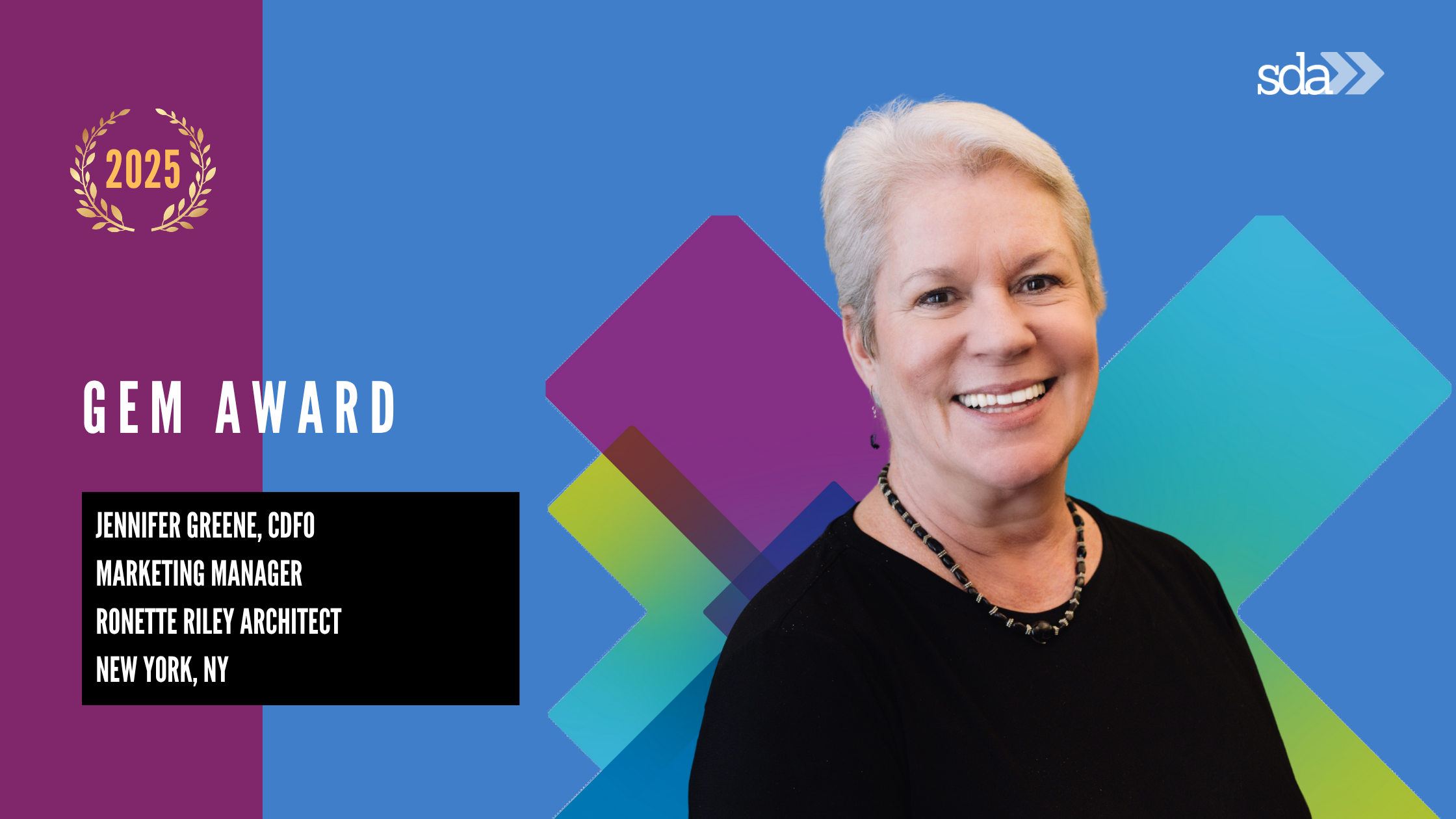
Amplifying SDA’s Voice: Jennifer Greene’s Leadership Earns 2025 GEM Award
Behind every strong professional community is a leader who ensures its message is heard, its value is clear, and its members feel connected. For SDA, that leader is Jennifer Greene, CDFA. Through her exceptional leadership as Chair of the MarCom Committee in 2023–2024 and Co-Chair in 2024–2025, Jennifer has helped shape the way SDA communicates, grows, and engages. Her service was formally recognized with the 2025 GEM Award—SDA’s highest honor for volunteerism—presented on May 22, 2025. A longtime SDA member, Jennifer exemplifies the commitment and professionalism that define our community.
Leading the Way
The GEM Award (Going the Extra Mile) is awarded annually by SDA to honor individuals who demonstrate extraordinary dedication through volunteer leadership. Jennifer Greene, CDFA, earned the 2025 distinction for her ongoing role leading the Marketing & Communications (MarCom) Committee during two pivotal years. As Chair and then Co-Chair, Jennifer worked to strengthen SDA’s messaging, increase member engagement, and elevate the organization’s visibility across the AEC industry. Her efforts directly supported SDA’s mission to empower operations professionals by ensuring that resources, achievements, and opportunities were communicated clearly and consistently. Jennifer’s contributions reflect not only her talent for strategic outreach, but also her unwavering commitment to the professional development of others.
A Career Built for Marketing
Jennifer Greene who is the Director of Marketing at Ronnette Riley Architect’s in New York, New York has dedicated years of leadership and thoughtful collaboration to SDA. As a Certified Design Firm Administrator (CDFA), she brings a deep understanding of both firm operations and professional communications—skills she has used to guide SDA’s MarCom team’s efforts with clarity and vision. Her ability to bring structure, creativity, and strategic thinking to SDA’s messaging helped enhance outreach, unify branding, and better inform members across the country. Jennifer’s leadership style is marked by reliability, inclusiveness, and a clear passion for supporting others. Her efforts have not only made SDA stronger—they have created a more connected, informed, and inspired member community. Her recognition with the GEM Award is a well-earned testament to her impact.
A Continued Leader
Jennifer’s work within SDA has strengthened the organization’s communications infrastructure—an often-invisible but essential part of supporting member engagement and retention. By championing clear and consistent messaging, Jennifer has played a critical role in SDA’s continued growth and visibility within the AEC industry. Her influence will continue through the tools, strategies, and content she helped develop.
Jennifer’s GEM Award honors not only her service—but her ability to inspire, connect, and lead with purpose. SDA is proud to celebrate her outstanding contributions and lasting impact.
Tags:
AEC Marketing
GEMAwards
Marketing
Professional Development
SDA
SDA National
Volunteer Leadership
Permalink
| Comments (3)
|
|
|
Posted By SDA National,
Tuesday, October 28, 2025
Updated: Monday, October 6, 2025
|
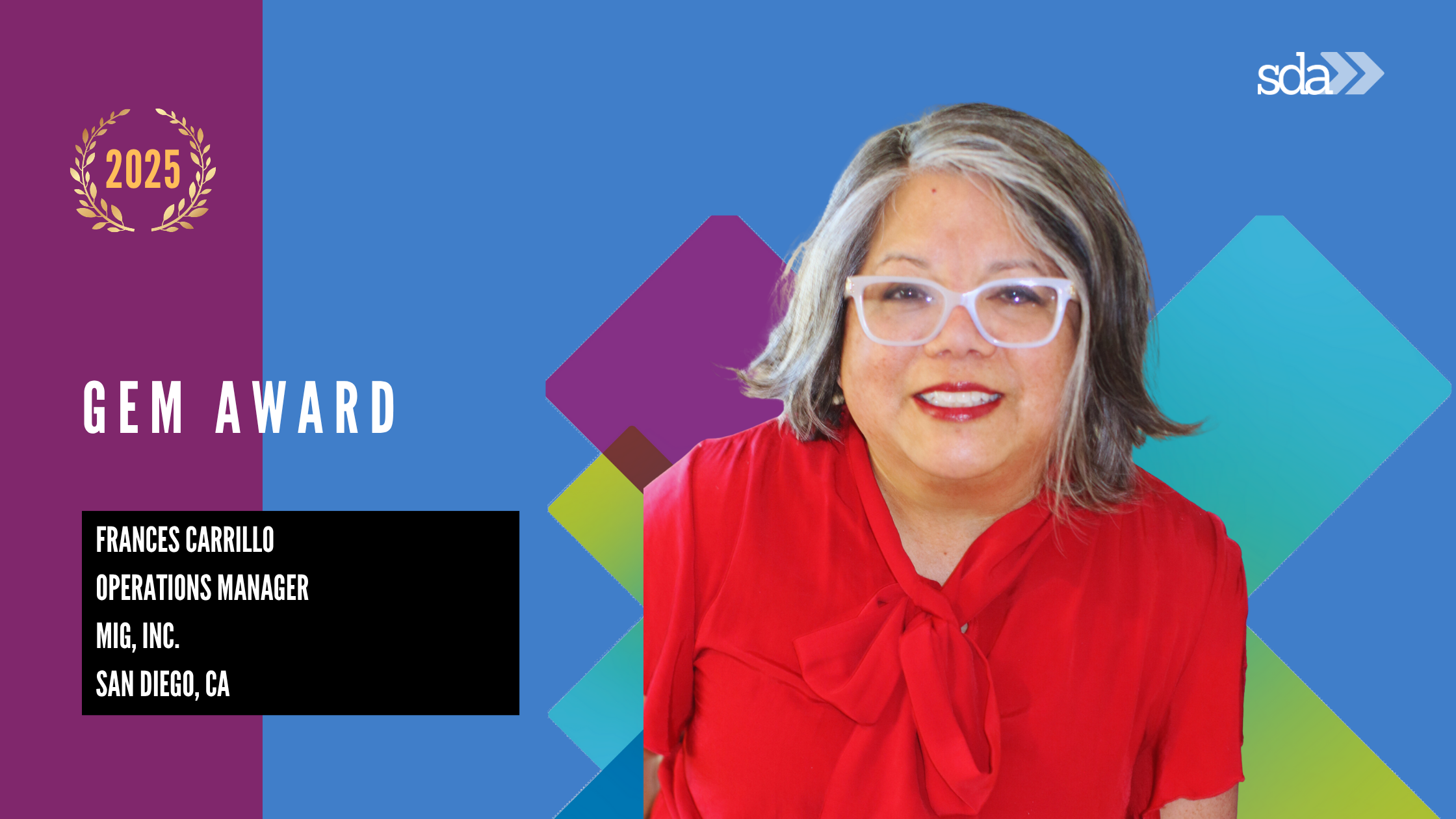
Exemplary leadership and service define Fran Carrillo’s contributions to the Society for Design Administration (SDA). As Operations Manager at MIG, Inc. in San Diego, Fran has long been recognized for her organizational insight and steady guidance. This year, her dedication earned national recognition with the GEM Award, honoring SDA members who serve as “Guiding Examples to our Members” through their significant contributions to the organization and its mission.
When Fran stepped into the role of Co-Chair of SDA’s Marketing and Communications (MarCom) Committee, she brought a collaborative energy that elevated the organization’s visibility and engagement across multiple platforms. The MarCom Committee oversees SDA’s marketing, public relations, social media, and publications—areas that reflect how SDA connects, informs, and celebrates its members. Through her leadership, Fran helped strengthen SDA’s brand voice and ensured that communications reflected the professionalism and spirit of the AEC community.
The GEM Award celebrates members whose service and influence shine throughout the SDA network, and Fran’s impact certainly fits that description. She first served as MarCom Co-Chair from 2020 to 2022, guiding the committee through a time when digital communication became more vital than ever. Returning to the role again for 2024 to 2025, Fran has continued to foster creative collaboration and consistency in how SDA presents itself to current and prospective members. Her ability to balance strategic vision with hands-on support exemplifies the type of leadership that strengthens the organization from within.
Fran’s professional journey at MIG, Inc. further reflects her commitment to excellence and teamwork. As Operations Manager, she supports a multidisciplinary design and planning firm known for its community-centered projects. Her dual perspective—rooted in both business operations and design collaboration—aligns perfectly with SDA’s mission to empower the professionals who keep AEC firms running smoothly and effectively. Within both her firm and SDA, Fran models the kind of leadership that values communication, mentorship, and shared success.
Her long-standing involvement in SDA highlights the power of professional engagement. Since joining the organization in 2017, Fran has contributed her time and expertise to advancing SDA’s visibility and resources for members. Under her guidance, the MarCom Committee’s initiatives have supported national campaigns, chapter outreach, and publications that spotlight member achievements—strengthening the bridge between local chapters and the national community.
Beyond her committee work, Fran’s influence extends through the connections she builds. Her approach demonstrates that effective communication is not only about messaging—it’s about meaning. She continues to inspire members by showing how thoughtful collaboration and steady commitment can create lasting value within professional organizations like SDA.
SDA National proudly congratulates Fran Carrillo on receiving the GEM Award. Her leadership, dedication, and enthusiasm exemplify what it means to serve as a guiding example for others. Through her efforts, SDA’s message of empowerment and professional excellence reaches farther and resonates deeper—reminding us all that the strength of our community lies in members like her.
Tags:
AEC Leaders
SDA
SDA National
SDA National Committee
Permalink
| Comments (1)
|
|
|
Posted By SDA National,
Friday, October 24, 2025
Updated: Friday, October 24, 2025
|

How one little dash can throw your automations, templates, and filenames into chaos
During our most recent First Friday Virtual Coffee, a seemingly simple question kicked off a surprisingly lively debate:
“How do you name your project files—year/month/day, year/day/month, or month/day/year?”
As members compared formats, the conversation turned to punctuation. One person said their firm was told not to use periods (.) in filenames. Another said they always use underscores (_). Someone else swore by hyphens (-).
And then someone asked, “Wait—does it matter which dash we use?”
That question stopped us in our tracks.
Because as it turns out, yes—it matters a lot more than most of us realize.
Why It Matters
Your computer sees a world of difference between a hyphen (-), an en dash (–), and an em dash (—)—even if your eyes don’t. Smart punctuation settings in Word, Google Docs, or macOS can “helpfully” replace a plain hyphen with one of the longer versions.
Those subtle swaps look harmless in text—but when used in filenames, automations, or templates, they can quietly break things.
An en dash or em dash in a file or field name can cause integrations to fail, automations to stop working, or exports to misread the label entirely. So if your workflow ever breaks for no apparent reason… your punctuation might be the hidden culprit.
Quick Fixes That Actually Work
- Hyphen (-) → ✅ Safe for file names and automations. Use it for joining short words or labels.
- Underscore (_) → ✅ Also safe. Common in code or legacy systems.
- En dash (–) / Em dash (—) → ❌ Save these for writing, not for filenames or templates.
- Periods and spaces → ⚠️ Avoid when possible; they can break URLs, links, or scripts.
Bottom line: boring punctuation is reliable punctuation. The plain hyphen will almost always win.
A Member-to-Member Tip
This entire post came out of SDA members sharing real experiences during First Friday Coffee—the kind of everyday troubleshooting that makes our community so valuable.
So if you’ve ever spent hours rebuilding an automation that “mysteriously stopped working,” double-check your punctuation before you panic. Sometimes, one tiny line is the whole problem.
Want to Dig Deeper?
If this kind of detail makes your inner systems nerd light up, you’ll love SDA member, Elizabeth Harris’s full guide on Substack.
The Extremely Niche, Mildly Unhinged Guide to Dashes (for Substack, Notion, and Zapier People)
It’s an entertaining deep dive into the world of dashes, underscores, and invisible formatting gremlins—with screenshots, examples, and even a “dash decoder” visual to help you spot the difference.
Keep the Conversation Going
Join us for our next First Friday Virtual Coffee to share what’s working in your firm—or to pick up a few new tricks from fellow members. You never know which casual question will spark your next great “aha” moment.
Tags:
AEC Learning
SDA
SDA National
Permalink
| Comments (3)
|
|
|
Posted By SDA National,
Thursday, October 16, 2025
Updated: Thursday, October 16, 2025
|

One of the most valuable aspects of earning the CDFO (Certificate in Design Firm Operations) is the way it connects leadership theory to practical application in the A/E industry. The CDFO isn’t just another credential — it’s a roadmap for understanding how operations, finance, people, and leadership all intersect to strengthen a firm.
John Maxwell’s 21 Irrefutable Laws of Leadership makes one thing crystal clear: leadership is influence, nothing more, nothing less. Titles, job descriptions, or authority might get short-term compliance, but they don’t inspire long-term loyalty or commitment. Authentic leadership happens when people choose to follow you — not because they must, but because they want to.
Influence Over Authority
Think about the best leader you’ve worked with. Chances are, it wasn’t their title that inspired you. Instead, it was their ability to connect, to communicate vision, and to make you feel part of something bigger than yourself. That’s the essence of influence.
By contrast, positional authority might secure short-term results, but it often creates dependency and fear. Influence builds trust, ownership, and momentum that outlasts a single project or even a leader’s presence.
What Does Influence as a Leadership Style Look Like?
When leaders adopt influence as their style, they move away from “command and control” and lean into inspiration and collaboration. Here are a few ways it shows up:
- Integrity and Character – People follow leaders they believe in.
- Relationships and Trust – Influence grows out of genuine connection, not transactions.
- Knowledge and Credibility – Expertise creates confidence in decision-making.
- Vision and Communication – A compelling “why” inspires others to commit.
- Consistency in Actions – Influence is earned every day, not in a single moment.
Real-World A/E Examples of Influence in Action
Influence isn’t reserved for the CEO or principal. It shows up across our firms in roles that, at first glance, might not look like “leadership” positions — but the impact is undeniable.
- The Controller Who Shapes Strategy
Even without being in a line position, a Controller with deep financial expertise can influence executive leadership. By identifying trends such as increases in chargeability or a decline in project multipliers, the Controller provides insights that directly impact decisions on staffing, pricing, and project delivery. Their credibility makes them a trusted advisor, and their influence extends beyond the accounting department to the entire firm’s bottom line.
- The Operations Professional Who Understands Contracts
An operations person who knows the ins and outs of contract language may not sign agreements, but their guidance helps project managers avoid pitfalls. By highlighting scope risks, billing terms, or liability concerns, they influence project setup and execution, saving the firm from costly missteps and strengthening client relationships.
- The PMA Who Masters Scheduling
A Project Management Assistant (PMA) who truly understands scheduling can anticipate resource conflicts before they become roadblocks. By providing clear, data-driven recommendations, they influence how project managers allocate people, prioritize tasks, and meet deadlines. Their influence ensures smoother delivery and greater client satisfaction — all without holding the official title of “project manager.”
These examples show that leadership through influence is alive across every discipline of an A/E firm. Expertise, credibility, and a willingness to share knowledge give professionals the ability to shape outcomes and elevate the entire organization.
Influence Creates Multipliers
The real power of influence is its ripple effect. A leader who models integrity, shares knowledge, and invests in people creates followers who in turn become leaders themselves. Influence multiplies through culture — shaping the way people treat each other, solve problems, and pursue goals long after the leader steps aside.
Practicing Influence Every Day
Leaders don’t wake up one morning suddenly influential. It’s a daily choice, built over time. Some practical steps:
- Listen more than you talk. Influence starts with understanding.
- Give credit generously. Recognition builds trust and loyalty.
- Mentor and empower. Help others succeed, and your influence grows naturally.
- Stay consistent. People respect what they can predict and rely on.
Final Thought
Influence isn’t just one aspect of leadership — it’s the essence of leadership. Authority may move people’s hands, but influence moves their hearts. And when hearts are engaged, results follow.
Leadership isn’t about the position you hold; it’s about the difference you make. Influence isn’t a tool in the leader’s toolkit — it is the toolkit.
If you’re ready to strengthen your leadership and influence in the A/E industry, the next step is clear: pursue the CDFO certification. It’s more than a credential — it’s an investment in yourself, your career, and the success of your firm.
Apply for the CDFO today and take the next step in your leadership journey.
Where do you have the most opportunity to lead through influence in your current role? Share in the comments below how you’re applying (or plan to apply) this kind of leadership in your daily work.
SDA does not endorse any products or services mentioned, and SDA does not assume responsibility for any circumstances arising out of the interpretation, application, use, or misuse of any information presented. SDA recommends that the reader consult the appropriate legal, financial, or human resource counsel before implementing the information contained herein.
Tags:
AEC Leadership
AEC Learning
CDFO
Certificate in Design Firm Operations
SDA National
Permalink
| Comments (2)
|
|
|
Posted By SDA National,
Friday, October 10, 2025
Updated: Friday, October 10, 2025
|
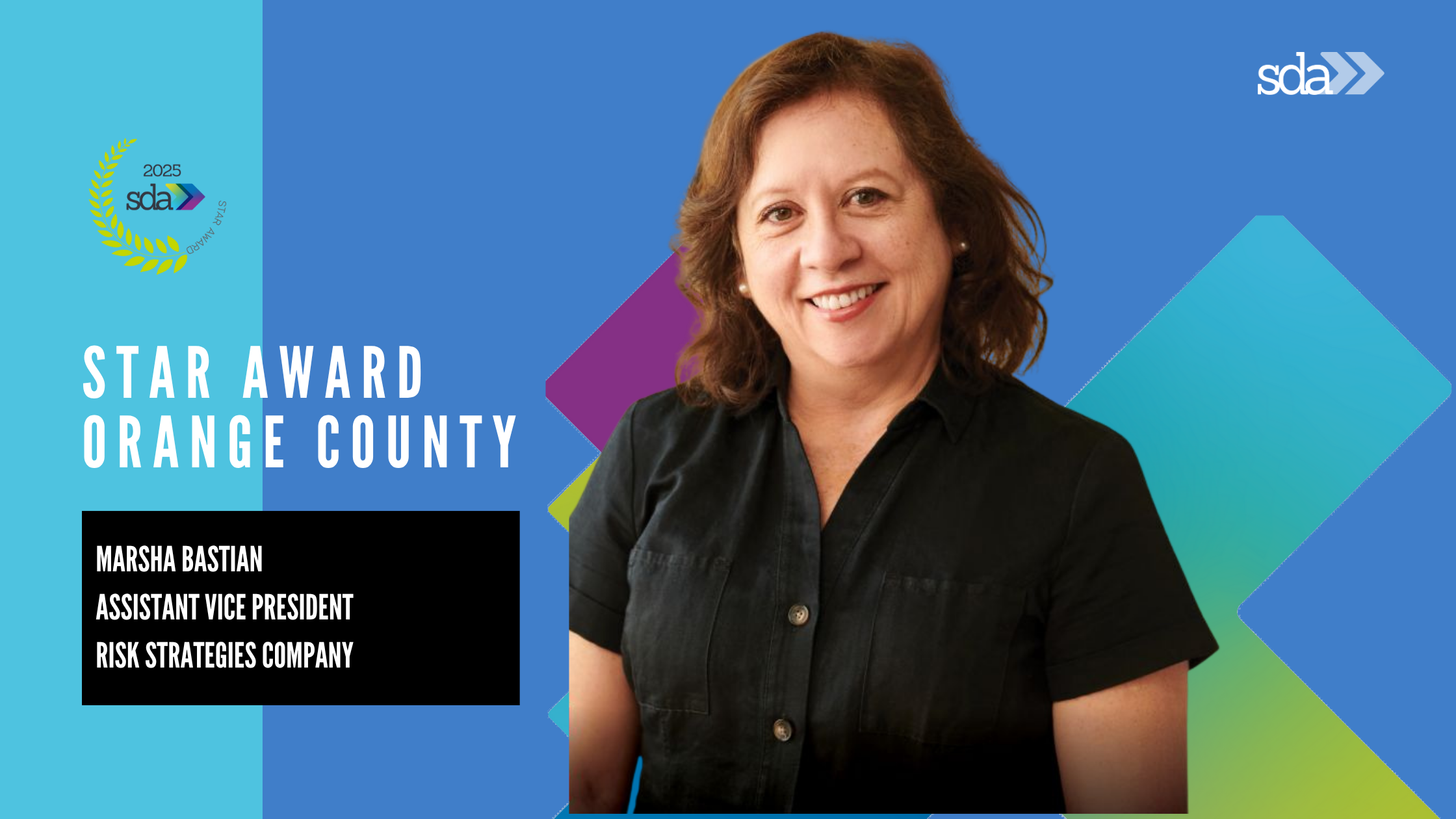
When it comes to dedication, reliability, and community spirit, SDA Orange County’s Marsha Bastian shines brightly. This year, her years of service and leadership earned her the SDA STAR Award, a national honor presented annually by each chapter of the Society for Design Administration to recognize outstanding members whose contributions exemplify SDA’s values of excellence, collaboration, and professional growth.
For more than five years, Marsha has served as Recording Secretary for SDA Orange County, maintaining detailed and accurate meeting minutes that keep the chapter’s operations running smoothly. Her precise documentation ensures that chapter leaders can reference decisions and discussions with confidence—an often unsung but essential role that reflects her professionalism and attention to detail. “Her notes have been a big help when needing to track what has been discussed or decided at previous business meetings,” shared a chapter colleague.
Beyond her secretarial duties, Marsha has strengthened SDA/OC’s programming by connecting the chapter with expert speakers from her insurance firm, Risk Strategies, helping organize multiple lunch seminars and webinars on topics vital to AEC business operations. Her willingness to share resources and expertise has enriched chapter education and engagement, providing valuable insight for members and their firms.
Marsha joined SDA in 2015, quickly becoming an active participant in nearly every chapter function—from board meetings and professional seminars to networking and social events. Her steady presence and enthusiasm have made her a cornerstone of the SDA/OC community. As one member noted, “She’s just not an attendee, she’s a participant,” a sentiment that captures the energy and initiative she brings to everything she does.
The STAR Award honors SDA members whose exceptional service advances both their chapter and the broader profession. Marsha’s recognition underscores the impact of her commitment to fostering professional excellence and connection within the AEC community. Her contributions demonstrate how consistent involvement, leadership, and generosity of knowledge strengthen the foundation of SDA as a whole.
SDA National congratulates Marsha Bastian on this well-deserved recognition. Her example reminds us that leadership takes many forms—and that attention to detail, collaboration, and community-minded service are at the heart of what makes the SDA thrive.
Tags:
AEC Leaders
SDA
SDA National
SDA Star Award
Permalink
| Comments (2)
|
|

 Blog Home
 All Blogs
 RSS
RSS