Welcome to our SDA Blog. We hope you enjoy the insights and information that will be shared here by our authors. Be sure to leave a comment and share with others.
As we conclude our Administrative Professionals Month celebration, SDA is reflecting on the professionals who keep A/E/C firms running—those who bring clarity, connection, and consistency to their organizations every day.
Throughout the month, we’ve shared stories of growth, connection, and leadership across our community.
This week, we’re sharing a perspective on how meaningful connections can support your growth, strengthen your confidence, and remind you that you’re not navigating this work alone by Susan Lankey, CDFA, Business Manager for DJG, Inc., in Williamsburg, VA.
One of the most powerful parts of being involved in SDA is the sense of connection that comes with it. Early in my involvement with SDA, I quickly realized that I had found more than just a professional organization—I had found a community of people who genuinely understand the challenges and opportunities that come with working in the A/E/C industry.
Attending SDA conferences has been one of the most impactful parts of my journey. Being able to connect in person with professionals from firms across the United States and Canada has opened the door to conversations that simply wouldn’t happen otherwise. Whether it’s discussing operational challenges, sharing best practices, or brainstorming solutions to issues within our firms, these connections have created a network of peers I can reach out to anytime. It’s incredibly reassuring to know that when a challenge arises, there is a group of knowledgeable professionals willing to share their experience and perspective.
Beyond the conferences, serving within SDA has also been a meaningful part of my professional growth. My time serving on our local chapter board, participating on national committees, and working alongside fellow leaders on EXCOM really pushed me to grow in ways I never expected. Each opportunity has helped me build confidence, strengthen my leadership skills, and develop a broader understanding of the industry.
What makes SDA so special is that these experiences don’t just stay within the organization—they carry back into our daily work. The lessons learned, the ideas shared, and the encouragement from peers all contribute to how we grow within our firms and how we support our teams.
For me, SDA has been a reminder that professional growth doesn’t happen in isolation. It happens through shared experiences, open conversations, and the willingness to learn from one another. The connections I’ve built through SDA continue to support and inspire me, and they are a big part of why I’m able to keep moving forward in my career.
Throughout this month, we’ve seen how growth, connection, and leadership come to life across our community—each one a reminder that wherever you are, SDA helps you go further.
If Susan’s story resonates with you, we invite you to continue the conversation:
Leave a comment below and share one connection or conversation that has helped you grow in your role
As part of our Administrative Professionals Month celebration, SDA is highlighting the professionals who keep A/E/C firms running—those who bring clarity, connection, and consistency to their organizations every day.
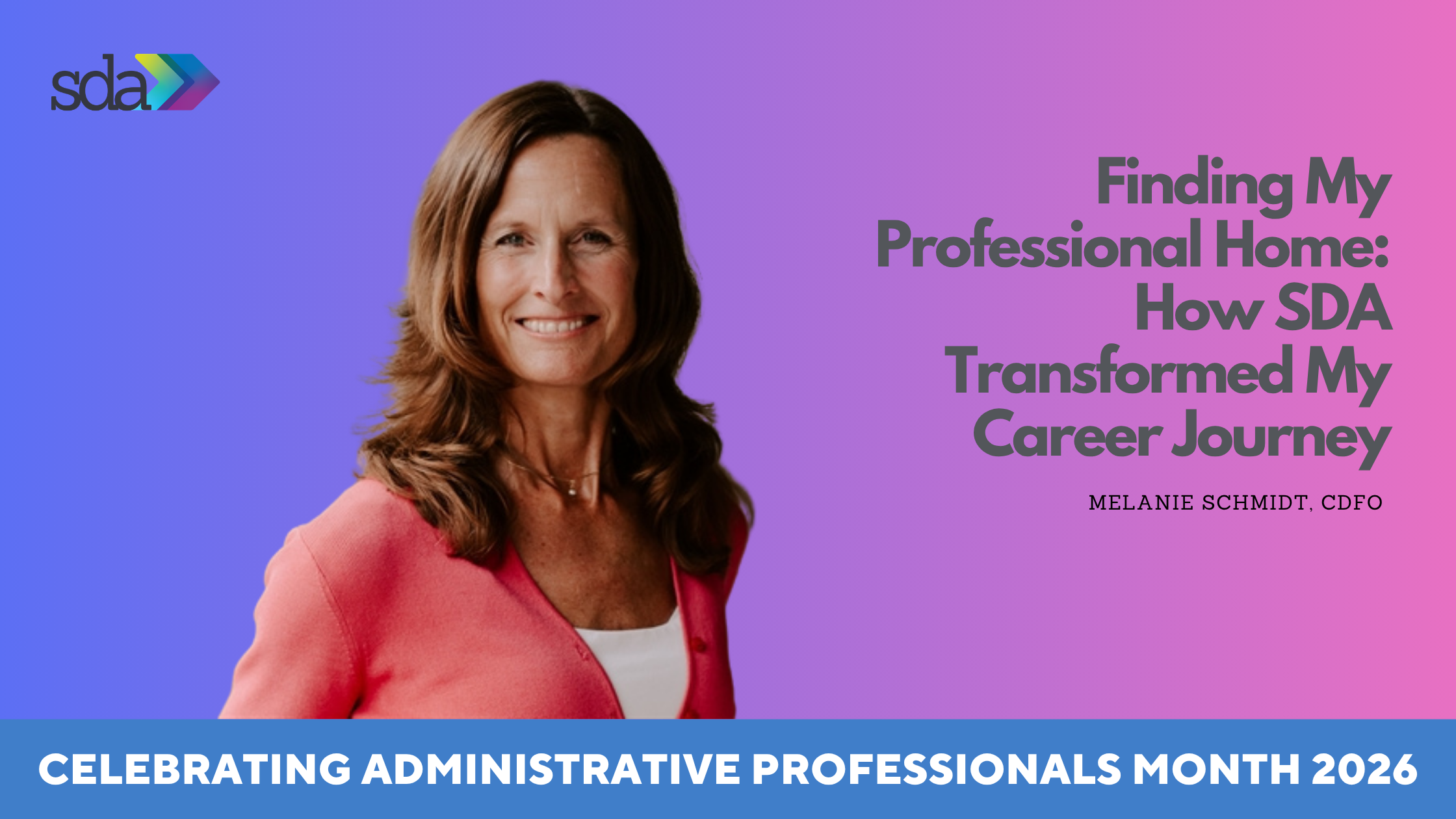
This week, we’re sharing a perspective on finding your professional home and growing with confidence through community and credentials by Melanie Schmidt, CDFO, Office Administrator for Snell Engineering Consultants in Sarasota, FL.
When I first stumbled upon the Society for Design Firm Administrators (SDA), I had no idea I was about to discover a professional community that would fundamentally change my career trajectory. Like many design firm administrators, I had been navigating the unique challenges of our industry primarily on my own, learning through trial and error, and often feeling isolated in my role. More importantly, SDA helped me find a way to turn what had been just a job into a true career with clear pathways for growth and professional development.
The Discovery That Changed Everything
My journey with SDA began most serendipitously. I had approached my Principal, also my supervisor, about advancing my career within the business, seeking guidance on professional development opportunities. As fate would have it, he had recently learned about SDA through a client conversation and immediately saw the potential value for my role. He forwarded the organization information to me and, recognizing the opportunity, told me the firm would support my membership in SDA and send me to EDSymposium, the yearly SDA conference. Three jam-packed days of learning, networking, and empowerment. But he didn't stop there – he challenged me with setting a goal of earning the CDFA credential.
That conversation was a pivotal moment in my career. Here was the Principal of my firm, not only supporting my professional development but actively encouraging me to pursue industry-specific credentials that would benefit both my growth and our firm's operations.
The architecture and design industry has its own particular administrative challenges—from project management complexities to unique billing structures, from managing creative personalities to understanding the intricacies of professional liability. Traditional business administration resources often fall short of addressing these specialized needs.
When I explored sdanational.org, I immediately recognized that I had found MY people. Here was an entire organization of A/E/C administrative professionals who understood exactly what I dealt with every day. The wealth of resources, the community of experienced professionals, and the commitment to advancing our profession were exactly what I had been searching for without even knowing it existed.
Growing Through Credentials: CDFA and CDFO
One of the most transformative aspects of my SDA membership has been pursuing and achieving both the Certified Design Firm Administrator (CDFA) and Certified Design Firm Operations (CDFO) credentials. These certifications have not only validated my expertise but have also provided structured learning opportunities that have made me significantly more effective in my role.
The CDFA Journey
Earning my CDFA credential was a comprehensive deep dive into the fundamentals of design firm administration. The program covered everything from financial management and human resources to project administration and business development support. What I appreciated most was how the curriculum was specifically tailored to our industry's unique needs. Instead of generic business principles, I was learning best practices that had been developed by and for design firm administrators.
The preparation process itself was incredibly valuable. It forced me to examine my own practices critically and identify areas for improvement. The networking opportunities with other CDFA candidates and certified professionals created lasting professional relationships that continue to benefit me today.
Advancing to CDFO
Building on the foundation of my CDFA, pursuing the CDFO credential allowed me to dive deeper into the operational aspects of design firm management. This advanced certification covers strategic planning, advanced financial management, leadership development, and organizational effectiveness – all crucial skills for senior administrators who want to contribute at a strategic level.
The CDFO program challenged me to think beyond day-to-day operations and consider how I could contribute to my firm's long-term success. It gave me the tools and knowledge to participate meaningfully in executive-level discussions about firm direction, growth strategies, and operational improvements.
The Value of Member at Large Status
Being a Member at Large with SDA has opened doors I didn't even know existed. This membership level provides access to an incredible network of professionals nationwide, each bringing their expertise and perspectives to our shared challenges.
The Ripple Effect of Professional Growth
The knowledge and connections I've gained through SDA haven't just benefited my career—they've made me a more valuable contributor to my firm and the broader design community. The best practices I've learned have improved our operational efficiency, the financial management techniques have contributed to better project outcomes, and the leadership skills have enhanced my ability to support our design teams effectively.
My colleagues have noticed the difference. I approach challenges more confidently, armed with proven strategies and a network of professionals I can consult when facing new situations. The credibility that comes with CDFA and CDFO certification has also elevated my standing within my firm and opened up new opportunities for leadership and growth.
Looking Forward
My journey with SDA continues to evolve. The organization's commitment to advancing the profession means there are always new learning opportunities, emerging best practices to explore, and ways to contribute to our professional community. Whether participating in research initiatives, mentoring newer administrators, or helping to develop new educational programs, SDA provides numerous avenues for ongoing engagement and growth.
I can't recommend it highly enough for any design firm administrator who has yet to discover SDA. Whether you're just starting your career or are a seasoned professional, the Society of Design Firm Administrators offers resources, community, and opportunities that can transform your professional journey.
The investment in SDA membership and credentials isn't just an investment in your career—it's an investment in advancing our entire profession. By joining this community of dedicated professionals, you become part of a movement elevating the standards and recognition of design firm administration.
Finding SDA wasn't just finding a professional organization – it was finding my professional home. And that home has made all the difference in my career journey.
If Melanie’s story resonates with you, we invite you to continue the conversation:
Leave a comment below to share your thoughts or encourage a fellow member
Posted By SDA National,
Wednesday, April 1, 2026
Updated: Wednesday, April 1, 2026
Subconsultants are essential to delivering successful projects—but managing them well is where operational excellence is truly tested, and where small breakdowns can quietly erode profitability and relationships alike.
At a recent SDA Roundtable, members came together for a candid conversation about the realities of subconsultant coordination: what's working, what isn't, and where firms are feeling the most pressure. The discussion made one thing clear—the technical work rarely creates the biggest headaches. It's the business side of subconsultant management that demands the most attention, and for many firms, that's an area still in need of refinement.
Where Firms Are Feeling the Pressure
Invoicing and financial tracking consistently surfaced as a top frustration. Missing project information, delayed submissions, and the manual effort required to reconcile subconsultant billing all contribute to cash flow uncertainty that compounds over time. Even firms with dedicated project management software often find themselves relying on spreadsheets to fill the gaps—a clear sign that tools alone aren’t solving the underlying process problems.
Scope creep was equally common—and costly. Work performed without clear authorization often goes undetected until the invoice arrives, at which point the conversation becomes difficult for everyone involved. In many cases, the issue isn't a subconsultant acting in bad faith; it's a project manager or team member making informal requests outside of established channels. Preventing it requires more than a well-written contract. It requires consistent internal communication and clearly defined approval processes that everyone on the team understands and follows.
Communication breakdowns extend further than scope management. Several members raised concerns about subconsultants interacting directly with clients without routing through the prime—a dynamic that blurs accountability, creates misalignment, and introduces real risk. Even when contracts specify communication protocols, real-world behavior doesn't always follow. Firms that have had the most success here address expectations explicitly at project kickoff, not just in the agreement itself.
Payment practices and insurance compliance rounded out the most commonly cited pressure points. The 'pay when paid' approach remains widespread, but its application varies considerably from firm to firm—and most members acknowledged that payment strategy is as much a relationship decision as a financial one. On the compliance side, tracking Certificates of Insurance across multiple subconsultants is still a largely manual process for many firms, and one that tends to be reactive rather than proactive.
What's Actually Working
Despite these challenges, the roundtable surfaced several practices that are making a meaningful difference—practical shifts that firms can implement right away. Project kickoff meetings that bring together PMs, accounting, and subconsultants early on consistently reduce downstream friction. Standardized contract templates—particularly firms moving toward their own agreements rather than signing subconsultant terms—provide stronger footing on scope, payment, and compliance from the start.
Regular internal check-ins help surface issues before they escalate, and centralized tracking systems, even imperfect ones, provide a single source of truth that scattered email threads simply cannot. Across the board, the firms navigating subconsultant relationships most effectively have invested in clear roles, documented expectations, and repeatable processes that don’t rely on institutional memory to function.
The most important takeaway may be this: most subconsultant challenges aren’t really about the subconsultants—they’re about us. They’re about the communication habits and internal consistency within our own firms—and those are things we have the ability to improve.
Hear the Full Conversation
Want to hear how your peers are tackling these challenges in real time? The full Roundtable recording dives deeper into the tools, workflows, and real-world scenarios shared during the discussion. Purchase the recording from the SDA Store and walk away with practical ideas you can apply immediately.
Question:How is your firm managing subconsultants—and where are you feeling the pressure? We’d love to hear what’s working for you. Tell us in the comments below.
SDA is always looking for ways to bring fresh perspectives to our members. We’re pleased to share this guest contribution from Rich Friedman, who explores how A/E/C firms are rethinking employee engagement in meaningful and lasting ways.
In an era defined by labor shortages, generational change, and rising employee expectations, engagement has become one of the most powerful drivers of retention, recruitment, and long-term stability.
But leading firms aren’t relying on generic programs. Instead, they’re creating distinct, firm-specific approaches that give employees a voice, reinforce values, and build real connection.
Here are three examples of what that looks like in action.
Recognition as Culture: Bergmeyer’s Unicorn Awards
At Bergmeyer, engagement starts with recognition—and not the top-down kind.
Their “Unicorn Award” is a monthly, peer-nominated program open to everyone in the firm. Employees nominate colleagues who demonstrate creativity, collaboration, or going above and beyond.
Rather than being a marketing initiative, the program is intentionally internal. Winners are celebrated at all-hands meetings and receive a custom handmade award, reinforcing that recognition is personal and meaningful.
What makes it work?
Peer-driven, not leadership-selected
Inclusive across all roles
Embedded into regular firm rituals
The result is a culture where people feel seen—not just for results, but for how they contribute.
Engagement Through Structure: MKSK’s Staff Council
MKSK takes a different approach—focusing on structure and voice.
After transitioning to a 100% ESOP, leadership recognized that while ownership had expanded, decision-making had not. Their solution: a Staff Council representing employees across offices and levels.
The council meets regularly, gathers feedback through informal conversations, and brings real issues to leadership—ranging from benefits to workplace policies.
What makes this effective:
Direct line between staff and leadership
Rotating participation to broaden involvement
Transparency about what can (and can’t) be implemented
An unexpected benefit?
The council has become a leadership development pipeline, giving emerging professionals insight into how decisions are made.
Stepping Away to Reconnect: The MKSK Design Summit
MKSK also invests in connection at a firmwide level through its annual Design Summit.
This two-day event brings employees together from across offices for:
Project tours and learning sessions
Peer connection and mentorship
External speakers outside the firm’s daily work
While the investment is significant, the return is clear:
Stronger relationships, shared identity, and a sense that employees are part of something bigger.
As one leader put it:
“It feels like a conference—but it’s ours. And that distinction matters.”
Different Approaches, Same Outcome
While these examples differ in style—from playful recognition to structured governance—they share one critical trait:
Intentionality.
Each firm has built engagement strategies that reflect its culture, not someone else’s template.
Engagement as a Strategy, Not an Add-On
The most successful firms don’t treat engagement as an HR initiative or occasional program.
They embed it into:
How decisions are made
How recognition happens
How leaders show up every day
There’s no one-size-fits-all solution—but there is a common principle:
Understand what your people value
Create ways for them to be heard
Reinforce it consistently
In today’s market, firms that do this well aren’t just improving culture—they’re building organizations people want to stay with.
Join the Conversation
What unique employee engagement strategies have worked in your firm?
Share your ideas in the comments—we’d love to continue the conversation and highlight additional approaches from across the SDA community.
This article has been adapted for SDA members from an original piece by Rich Friedman.
Posted By SDA National,
Thursday, July 3, 2025
Updated: Thursday, July 3, 2025
Rounding out our 2025 National Executive Committee spotlight series is Kim Celenza, Past President of SDA and Marketing Manager at JFK&M Consulting Group in New York. A longtime leader and advocate for SDA, Kim brings a wealth of experience, a sharp strategic eye, and a deep passion for the profession. As Past President, she continues to play an essential role in mentoring leadership, guiding big-picture strategy, and championing the growth of SDA across the A/E/C industry.d reinforcing our reputation as the go-to resource for best practices in the A/E/C industry.
Serving as SDA’s National President was both an honor and a responsibility I embraced with dedication. I’m proud of the progress we made together—advancing key initiatives, strengthening our member value, and reinforcing SDA’s role as the voice for business operations professionals in the A/E/C industry.
Now, as Past President, I remain committed to supporting the organization’s continued success. I look forward to mentoring new leaders, offering historical perspective when helpful, and contributing to strategic conversations that shape our future. It’s an exciting time for SDA, and I’m confident the path forward is bright.
Kim’s passion for growth and excellence continues to shape SDA’s future. Her commitment to clarity, collaboration, and high standards sets a powerful tone for our organization. Inspired by her vision? Help us grow the SDA network—talk about it, share what it’s done for you, and bring a colleague into the fold. Together, we can build something even stronger.

 Blog Home
 All Blogs
 RSS
RSS